+86 13110089902
 bella.zhang@free-optic.com

Comment fonctionne une machine de marquage laser sur verre?
25 décembre 2025
A machine de marquage laser du verre est un outil de précision conçu pour créer des marques permanentes sur les surfaces en verre sans contact physique. Les produits en verre étant largement utilisés dans l'électronique, les composants automobiles, les appareils médicaux, les équipements de laboratoire et les biens de consommation, les fabricants ont besoin de solutions de marquage précises, propres et durables. La technologie du marquage laser répond à ces besoins en utilisant une énergie laser contrôlée pour modifier la surface du verre à un niveau microscopique.
Contrairement aux méthodes traditionnelles telles que le sablage ou l'impression à l'encre, le marquage laser offre une grande répétabilité, une contrainte minimale sur le matériau et une excellente qualité esthétique, ce qui en fait la solution privilégiée pour le traitement moderne du verre.
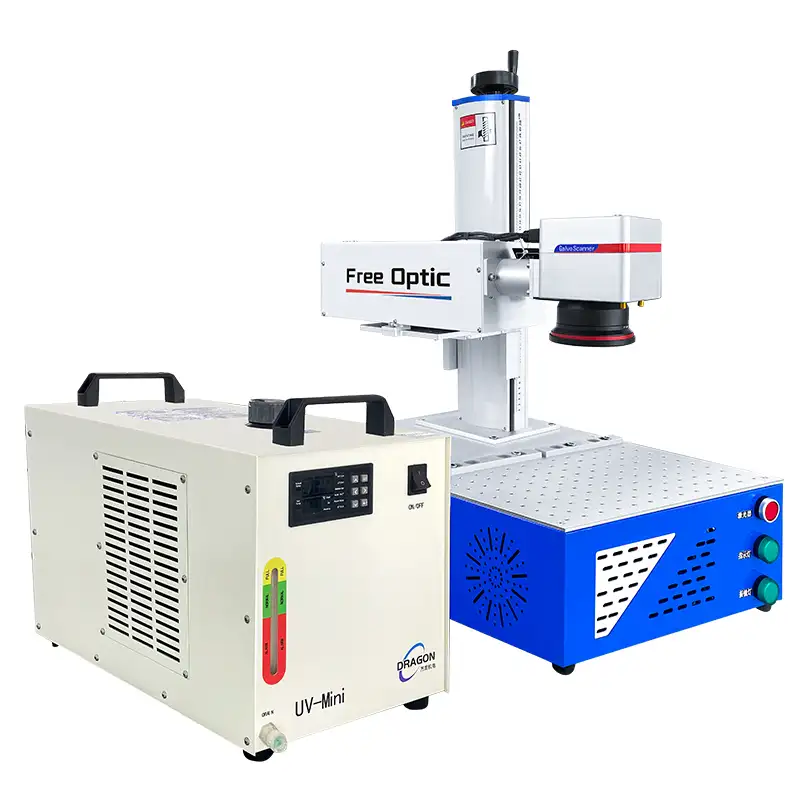
Principe de fonctionnement de base du marquage laser du verre
Le principe de fonctionnement d'une machine de marquage laser du verre repose sur l'interaction entre l'énergie laser focalisée et la surface du verre. Lorsque le faisceau laser frappe le verre, il génère des contraintes thermiques localisées ou des micro-fractures dans le matériau. Ces changements contrôlés créent des marques visibles telles que du texte, des logos, des numéros de série ou des codes QR.
Le processus est sans contact, ce qui signifie qu'il n'y a pas d'usure de l'outil ni de pression mécanique appliquée au verre. Ceci est particulièrement important pour les composants en verre fins, fragiles ou de haute précision, pour lesquels les méthodes de gravure conventionnelles pourraient provoquer des fissures ou des cassures.
Moderne Machines de marquage au laser sont conçus pour contrôler avec précision la puissance du laser, la fréquence des impulsions et la vitesse de balayage, ce qui garantit une qualité de marquage constante sur différents types et épaisseurs de verre.
Types de sources laser utilisées pour le marquage du verre
Les machines de marquage laser du verre utilisent généralement des lasers UV, des lasers CO₂ ou des lasers à impulsions ultra-courtes, en fonction de l'application. Les lasers UV sont particulièrement efficaces pour le verre en raison de leur courte longueur d'onde, qui permet un traitement à froid avec un minimum de zones affectées par la chaleur. Cela permet d'obtenir des marques lisses et contrastées avec un risque réduit d'écaillage.
Les lasers CO₂ sont souvent utilisés pour le verre plus épais ou le marquage décoratif, produisant des effets givrés ou mats sur la surface. Les lasers à impulsions ultracourtes sont utilisés dans des applications haut de gamme où une précision de l'ordre du micro-niveau et un impact thermique minimal sont requis.
Free Optic développe des systèmes de marquage laser avec des sources laser optimisées pour répondre aux exigences spécifiques du marquage du verre, garantissant une efficacité élevée et des performances stables dans les environnements industriels.
Processus de marquage étape par étape
Le processus de marquage commence lorsqu'un fichier de conception est importé dans le logiciel de contrôle laser. Le système traduit le dessin en trajectoires précises de déplacement du laser. La pièce de verre est positionnée sur un support ou un système de transport afin de garantir un alignement précis.
Une fois le laser activé, le faisceau est focalisé sur la surface du verre par un système optique de haute précision. Le laser balaie rapidement la surface, induisant des changements micro-structurels qui forment le marquage souhaité. L'ensemble du processus ne prend que quelques secondes et produit des marques permanentes qui résistent à l'usure, aux produits chimiques et aux températures élevées.
En tant que professionnel machine laser pour le marquage Free Optic met l'accent sur la stabilité du logiciel et la précision optique afin de garantir des résultats reproductibles, même en cas de production en grande quantité.
Avantages du marquage laser sur le verre
Le marquage laser offre plusieurs avantages qui le rendent idéal pour les applications sur verre. Le processus est propre et respectueux de l'environnement, car il ne nécessite pas d'encres, de solvants ou de consommables. Les marques sont permanentes et ne s'effacent pas avec le temps.
Un autre avantage clé est la flexibilité. Une seule machine de marquage laser sur verre peut traiter différents designs, tailles et contenus de marquage en modifiant simplement le fichier numérique. Cela permet aux fabricants de s'adapter rapidement aux mises à jour de produits ou aux demandes de personnalisation sans changer de matériel.
En outre, le marquage au laser préserve l'intégrité de la structure du verre lorsque les paramètres sont correctement contrôlés, ce qui permet de réduire les taux de rebut et d'améliorer l'efficacité globale de la production.
Applications des machines de marquage laser du verre
Les machines de marquage laser du verre sont largement utilisées dans les industries où la traçabilité et le marquage sont essentiels. Dans l'industrie électronique, elles marquent les panneaux de verre, les couvercles de caméra et les composants d'affichage. Dans le domaine médical, elles sont utilisées pour marquer les seringues en verre, les flacons et les récipients de laboratoire avec des codes d'identification précis.
Les constructeurs automobiles utilisent le marquage laser pour apposer des étiquettes permanentes et des informations de sécurité sur les pièces en verre. Les entreprises de biens de consommation font appel au marquage laser pour créer des logos décoratifs et des marques de qualité sur les bouteilles et les emballages en verre.
Face à la demande croissante d'automatisation, de nombreux fabricants se tournent vers ligne de production machine de marquage au laser qui peuvent fonctionner en continu dans le cadre de flux de travail automatisés.
Intégration dans les chaînes de production automatisées
Une machine de marquage laser du verre peut être facilement intégrée dans des lignes de production automatisées. Ces systèmes fonctionnent en synchronisation avec les convoyeurs, les bras robotisés et les unités d'inspection par vision pour marquer les produits en verre en temps réel.
L'intégration à la chaîne de production permet un marquage cohérent à grande vitesse sans interrompre le flux de production. Elle permet également le suivi des données en temps réel, ce qui permet aux fabricants de relier chaque code marqué aux registres de production et aux systèmes de contrôle de la qualité.
Free Optic fournit des solutions de marquage laser personnalisées pour les lignes de production, conçues pour une intégration transparente, assurant un fonctionnement stable même dans des environnements industriels exigeants.
Contrôle de la qualité et cohérence
Le maintien d'une qualité de marquage constante sur le verre nécessite un contrôle précis des paramètres et du positionnement du laser. Les machines avancées de marquage laser sur verre sont équipées de scanners galvanométriques à grande vitesse, de sources laser stables et de logiciels intelligents pour garantir des résultats uniformes.
Des systèmes de vision peuvent être ajoutés pour inspecter les marquages immédiatement après le traitement, afin d'en garantir la lisibilité et la conformité aux normes industrielles. Ce contrôle en boucle fermée améliore considérablement les taux de rendement et réduit les reprises.
Évolution future de la technologie de marquage du verre par laser
Alors que la fabrication s'oriente vers les usines intelligentes et la production numérique, la technologie de marquage laser du verre continue d'évoluer. Les tendances incluent des lasers de plus grande précision, l'optimisation des paramètres assistée par l'IA et une intégration plus profonde avec les systèmes d'exécution de la fabrication.
Les fabricants exigent de plus en plus des systèmes flexibles capables de traiter plusieurs types de produits tout en conservant une grande efficacité. Des entreprises comme Free Optic continuent d'innover en matière de contrôle laser, de compatibilité avec l'automatisation et de fiabilité des systèmes pour répondre à ces besoins en constante évolution.