+86 13110089902
 bella.zhang@free-optic.com

Expert Guide to How Much Are Laser Marking Machine in 2026: 5 Key Cost Factors
January 5, 2026
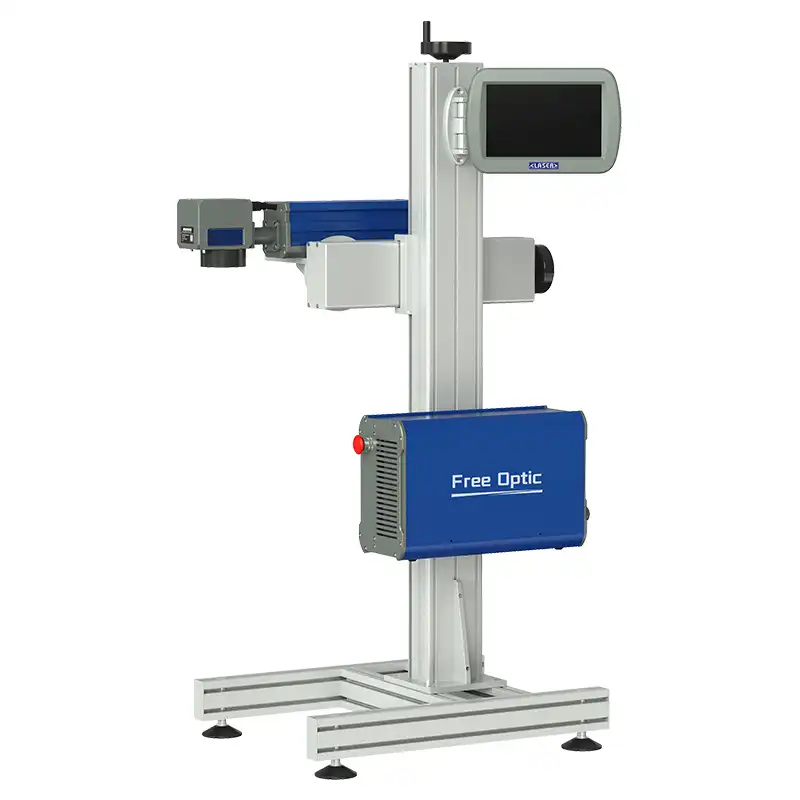
When budgeting for industrial upgrading or starting a custom engraving business, the most critical question is always: How much does a laser marking machine cost in 2026?
The short answer is: Prices typically range from $1,500 for entry-level portable units to over $20,000 for fully automated, high-end production systems.
However, buying a laser marking machine is not just about the price tag; it’s about choosing the right configuration to maximize your return on investment (ROI). To help you make an informed decision and avoid overpaying, Free-Optic has broken down the 2026 laser marking pricing landscape and the 5 key cost factors behind it.
2026 Cost Breakdown by Laser Technology
| Laser Technology Type | Core Power Options | Target Materials | 2026 FOB Price Range (USD) | Core Cost Driver (2026 Trend) |
| Fiber Laser Marking | 20W, 30W, 50W, 100W | Metals, Rigid Plastics | $1,500 – $4,500 | Price drop in 20W/30W modules due to manufacturing scale; MOPA lasers remain premium. |
| UV (Ultraviolet) Laser | 3W, 5W, 10W | Glass, Plastics, Electronics | $3,200 – $7,500 | High stability cooling systems and crystal components sustain higher R&D overhead. |
| CO2 Laser Marking | 30W, 60W, 100W | Wood, Leather, Acrylic, Paper | $1,800 – $3,800 | Mature glass/metal tube technology keeps costs stable; highly competitive market. |
How 2026 Global Logistics Shape Your Actual Landed Cost
When budgeting for an industrial laser marker, the FOB (Free on Board) factory price is only half the equation. To calculate your true ROI, international B2B buyers must evaluate current supply chain dynamics and ocean/air freight fluctuations. In 2026, shipping logistics to prime markets like Europe and Latin America show distinct variance:
-
European Market (CIF / DDP Trends): Shipping to European base ports (Rotterdam, Hamburg, Felixstowe) continues to adapt to volatile maritime routes. While traditional ocean freight remains the most cost-effective approach for bulk factory orders, premium buyers balancing tight production schedules are opting for sea-air combined transport. Additionally, customs clearance fees and strict local import compliance verification add a baseline 5-8% to the final landed cost.
-
Latin American Market (Surcharges & Transit Times): Logistics routing to South American ports (such as Manzanillo, Callao, or San Antonio) faces historical capacity adjustments and seasonal peak surcharges. For example, a standard pallet holding a desktop fiber laser marking machine requires specialized packing to counter maritime humidity. Buyers in Mexico and Chile should anticipate that localized port congestion and inland trucking fees can occasionally equal or exceed the base ocean freight rate itself.
To optimize your procurement budget, we highly recommend shifting from standard FOB terms to CIF (Cost, Insurance, and Freight) agreements. This allows our factory logistics team to leverage volume-based carrier contracts, mitigating unexpected spot-market rate spikes for your delivery.
5 Key Factors That Determine Laser Marking Machine Costs
Why do two machines that look identical have a $3,000 price difference? It all comes down to these 5 core internal components:
1. The Laser Source Brand & Type (The “Heart” of the Machine)
The laser source accounts for up to 40%-60% of the total machine cost. Premium international brands like IPG Photonics offer ultimate stability but come with a hefty price tag. For 2026, top-tier Chinese brands like Raycus and Maxphotonics have become the global standard for offering European-level beam quality at a much more competitive wholesale cost.
2. Laser Power Output (20 W or 30 W, 50 W or 100 W)
Higher wattage equals faster marking speeds and deeper engraving capabilities.
-
A 20 W or 30 W fiber laser is perfect for shallow surface marking (barcodes, logos).
-
A 50 W or100 W deep engraving laser source will cost significantly more but is mandatory for high-speed automated industrial assembly lines.
3. Galvanometer Scanner & Field Lens Precision
The galvanometer (the high-speed mirrors that guide the laser beam) dictates the accuracy and micro-level detail of your marking. Upgrading from a standard scanner to a premium digital high-speed scanner ensures zero distortion at high speeds, which naturally adds to the manufacturing cost.
4. Machine Form Factor: Portable vs. Enclosed Cabinet
-
Desktop / Portable Lasers: Highly cost-effective and space-saving, ideal for small workshops or mobile engraving setups.
-
Fully Enclosed Class 1 Cabinets: Feature built-in laser safety glass, automated Z-axis lifting, and fume extraction routing. These safety features comply strictly with European CE/FDA workplace regulations but increase the initial machine price.
5. Custom Software & Industrial Automation Integration
Standard EZCAD software is usually included at no cost. However, if your system requires custom software plugins, dynamic rotary axes for cylindrical marking, or integration into a conveyor belt system with visual CCD cameras for automated part alignment, these custom ODM modifications will scale up the quote.
Sourcing Smart: How to Maximize Your ROI with Free-Optic
At Free-Optic, we don’t believe in making you pay for features you will never use. When you source your industrial equipment from us, you bypass the massive markups of local distributors while securing top-tier component integration.
-
100% Certified Quality: Our fiber, CO2, and UV laser marking machines comply with international safety standards, ensuring smooth customs clearance.
-
Factory-Direct Pricing: We optimize our supply chain to pass the savings directly to our B2B partners, offering premium-build machinery at highly competitive global wholesale rates.
-
Lifetime Technical Support: Every Free-Optic machine comes backed by our engineering support team, minimizing your operational downtime.
Get an Accurate Quote in 24 Hours
Stop guessing your budgeting parameters. Let our engineering team build a configuration tailored precisely to your production speed, safety compliance, and material type.
[Contact Free-Optic Now] to upload your product samples for free test marking, download our 2026 Full Machinery Spec Catalog, and claim your factory-direct wholesale pricing today!
Frequently Asked Questions
1. How much are laser marking machine models for a small business?
For a small business, a great starting point is typically a 20W or 30W desktop fiber laser machine, which in 2026 generally costs between $2,500 and $5,000. This is ideal for marking metals and many plastics and is perfect for applications like personalizing products, marking tools, or adding serial numbers.
2. What is the main price difference between a fiber laser and a CO2 laser?
At the entry-level, a basic fiber laser and a basic glass-tube CO2 laser can have similar prices. The main price divergence occurs with higher-quality components. An industrial-grade CO2 laser with a long-life RF metal tube will be significantly more expensive than a standard fiber laser of equivalent power. The choice depends entirely on the materials you need to mark: fiber for metals and CO2 for organics like wood and acrylic.
3. Is a more expensive laser marking machine always better?
Not necessarily. “Better” depends on your specific needs. A very expensive, high-power machine is “worse” if you only need it for light surface marking, as you have overpaid for capability you will not use. The best machine is the one that meets your application requirements for material, speed, and quality at the most efficient price point.
4. Can I use a laser marking machine for cutting?
Generally, laser marking machines are optimized for surface marking and engraving, not cutting. While a higher-power (50W+) fiber laser can cut very thin metal sheet (typically under 1mm), it is a slow process. Similarly, a CO2 laser marker can cut thin wood or acrylic. However, for efficient cutting, you need a dedicated laser cutting machine with a different nozzle design and gas-assist system.
5. Why are UV laser marking machines so expensive?
UV lasers are more expensive due to their complexity. They start with an infrared laser source (similar to a fiber laser) and use special non-linear crystals to convert the light’s wavelength into the ultraviolet spectrum. This process, known as frequency generation, requires precise alignment and high-quality, expensive optical components, which drives up the manufacturing cost.
6. What ongoing costs should I expect after buying a laser marking machine?
For fiber, MOPA, and UV lasers, ongoing costs are very low, primarily consisting of electricity and potentially replacing filters in your fume extractor. They are considered virtually maintenance-free. For CO2 lasers with glass tubes, the tube itself is a consumable and will need to be replaced after a few thousand hours of use, which represents a significant future cost.
7. How do I choose between a 20W and a 50W fiber laser?
Choose a 20W laser if your primary task is surface marking and you are not in a high-volume production environment. It offers the best value for money. Choose a 50W laser if you need to mark parts very quickly (e.g., on a production line) or if you need to do deep engraving into metal. The 50W provides a significant boost in speed and depth for a moderate increase in price.
References
- Hantencnc. (2022). Full list of laser machines. Hantencnc.com. Retrieved from
- Hispeed Laser. (n.d.). Laser machines for marking, cutting, cleaning, and welding. Hispeedlaser.com. Retrieved from
- Laserax. (2025). Laser manufacturer of marking & cleaning solutions. Laserax.com. Retrieved from
- LaserChina. (n.d.). Buy laser welder | cleaner | cutter | marker from manufacturer. Laserchina.com. Retrieved from
- LaserStar Technologies. (2025). LaserStar technologies | Laser welding, marking & cutting systems. Laserstar.net. Retrieved from
- Free Optic. (n.d.). China laser marking machine manufacturers. Free-optic.com. Retrieved from https://www.free-optic.com/laser-marking-machine
- Free Optic. (n.d.). OEM fiber laser marking machine manufacturer and supplier. Free-optic.com. Retrieved from https://www.free-optic.com/fiber-laser-marking-machine
- Ready, J. F. (2001). LIA handbook of laser materials processing. Laser Institute of America.
- Steen, W. M., & Mazumder, J. (2010). Laser material processing. Springer.
- Zaeh, M. F., & Pieczona, S. J. (2006). Laser processing of plastics. Journal of Laser Applications, 18(4), 247-253. https://doi.org/10.2351/1.2355523