+86 13110089902
 bella.zhang@free-optic.com

Expert Guide to How Much Are Laser Marking Machine in 2026: 5 Key Cost Factors
January 5, 2026
Abstract
An inquiry into the financial investment required for laser marking technology in 2026 reveals a complex pricing structure influenced by multiple interdependent variables. This analysis examines the primary determinants of cost for a laser marking machine, moving beyond a superficial price list to a nuanced exploration of the underlying technology. The investigation focuses on five principal factors: the type of laser source (Fiber, CO2, UV, MOPA), the laser’s power output (wattage), the quality and configuration of system components, the extent of software and automation integration, and the value of supplier support and total cost of ownership. By deconstructing the price into these constituent parts, this document provides a comprehensive framework for prospective buyers, particularly in the emerging industrial markets of Southeast Asia and the Middle East. The objective is to equip both small-scale entrepreneurs and large industrial enterprises with the necessary knowledge to make an informed and economically sound investment decision, aligning technological capabilities with specific application needs and budgetary realities.
Key Takeaways
- The laser source (Fiber, CO2, UV) is the single biggest factor determining machine cost.
- Higher wattage increases marking speed and depth, directly impacting the final price.
- Component quality, like the lens and galvo scanner, significantly influences performance and cost.
- The question of how much are laser marking machine prices is answered by your specific application needs.
- Automation features, such as flying marking, can substantially increase the total system investment.
- Consider total cost of ownership, including support and warranty, not just the initial purchase price.
Table of Contents
- Understanding the Landscape: What is a Laser Marking Machine in 2026?
- Factor 1: The Heart of the Machine – Laser Source and Its Impact on Price
- Factor 2: Power and Performance – How Wattage Determines Cost and Capability
- Factor 3: The Supporting Cast – Components, Configuration, and Build Quality
- Factor 4: Beyond the Machine – Software, Automation, and Customization
- Factor 5: The Human Element – Supplier, Support, and Total Cost of Ownership
- A Practical Guide to Budgeting: Price Ranges in 2026
- Frequently Asked Questions (FAQ)
- Conclusion
- References
Understanding the Landscape: What is a Laser Marking Machine in 2026?
Before we can properly address the central question of how much are laser marking machine systems, it is essential to build a foundational understanding of what this technology represents. To think of it merely as a “printer” for metal or plastic is to miss the profound elegance of its operation. At its core, a laser marking machine is a sophisticated instrument that uses a highly concentrated beam of light to create a permanent mark on a surface. This is not like applying ink that sits atop the material; instead, the laser interacts with the material itself, fundamentally altering it in a small, controlled area.
The Core Principle: Light as a Precision Tool
Imagine focusing the entire energy of the sun through a magnifying glass onto a single point. You are concentrating thermal energy to create a change—a burn mark. A laser marking machine operates on a similar principle but with a level of precision and control that is almost unimaginable. The term “laser” is an acronym for Light Amplification by Stimulated Emission of Radiation. In simple terms, the machine excites atoms within a medium (the laser source), causing them to release particles of light called photons. These photons are then amplified and directed into a coherent, single-wavelength beam of immense energy.
This beam is then guided by a pair of computer-controlled mirrors, known as a galvanometer or “galvo,” which can move with incredible speed and accuracy. These mirrors direct the laser beam across the surface of the target object, essentially “drawing” the desired mark—be it a serial number, a barcode, a logo, or a complex design. The interaction between the laser and the material can take several forms: foaming (melting the surface to create bubbles that form a light mark), carbonization (heating organic materials to create a dark mark), engraving (vaporizing material to create a cavity), or annealing (heating a metal to cause oxidation on the surface, creating a high-contrast black mark without removing material).
Evolution of Marking: From Mechanical Engraving to Photonic Precision
For centuries, creating permanent marks meant physically displacing material. Think of a chisel striking stone or a diamond-tipped tool scratching into metal. These methods, while effective, have limitations. They are often slow, create wear and tear on the tools, and can induce stress in the material being marked. Inkjet and pad printing offered a faster, non-contact alternative, but the marks are not truly permanent and can be worn away by abrasion or chemicals.
The advent of the laser marking machine represents a paradigm shift. It is a non-contact process, meaning no tool ever touches the part. This eliminates tool wear and reduces the mechanical stress on the component. The marks are created at the molecular level, making them as permanent as the material itself. The process is incredibly fast, with modern systems marking complex codes in fractions of a second. This combination of permanence, speed, and precision is why laser technology has become the gold standard in industries from aerospace and medical device manufacturing to jewelry and consumer electronics.
Why the Shift to Lasers? Permanence, Speed, and Versatility
The compelling case for adopting laser technology rests on three pillars. First, permanence. For traceability in automotive or medical fields, a mark must last the lifetime of the product. A laser-etched Data Matrix code on an engine block or a surgical instrument will remain legible through heat, chemical exposure, and physical wear. Second, speed. In a high-volume production line, every second counts. A laser can mark a part as it moves down a conveyor belt without slowing the process. Third, versatility. The same machine, with adjustments to its parameters, can mark a delicate silicon wafer, a rugged steel component, or a piece of wood. This flexibility makes it a powerful tool for a vast range of applications. Understanding this value proposition is the first step in contextualizing the discussion of cost. The price of the machine is not just for the hardware; it is for the capability it brings to a business.
Factor 1: The Heart of the Machine – Laser Source and Its Impact on Price
When we begin to dissect the question of how much are laser marking machine systems, we must start with the single most significant component: the laser source. This is the engine of the entire system, the element that generates the beam of light. The type of laser source dictates which materials the machine can mark, the quality of the mark, and, to a very large extent, the final price tag. In 2026, four types of laser sources dominate the market: Fiber, CO2, Ultraviolet (UV), and MOPA. Each has a distinct physical process, a unique set of applications, and a different cost structure.
Fiber Lasers: The Industrial Workhorse
If you have seen a permanent black mark on a metal tool, an aluminum phone casing, or a plastic electrical component, you have likely seen the work of a fiber laser marking machine. These have become the dominant technology for marking most metals and many plastics due to their efficiency, long lifespan, and maintenance-free operation.
The technology itself is a marvel of optical engineering. The “gain medium” is an optical fiber that has been doped with a rare-earth element, typically ytterbium. This fiber is “pumped” with light from simple laser diodes. The ytterbium atoms in the fiber absorb this pump light and are excited to a higher energy state. When they drop back down, they emit photons at a specific wavelength (around 1064 nm). These photons are trapped within the fiber, stimulating other excited atoms to release identical photons, thus amplifying the light into a powerful, high-quality beam.
Because the entire process happens within a flexible fiber, the system is robust, compact, and requires no mirrors to align or clean. The lifespan of a fiber laser source, often exceeding 100,000 hours, means it can run for over a decade in a standard single-shift operation. This reliability makes it ideal for industrial environments in places like the automotive manufacturing hubs in Turkey or the electronics assembly lines in Vietnam. The cost of a fiber laser marking machine is influenced by the brand of the source (e.g., industry leaders like IPG versus cost-effective options like Raycus or JPT) and its power, but a typical 20W-30W system represents the most common entry point into professional laser marking.
CO2 Lasers: The Master of Organics
While fiber lasers excel with metals, they are largely ineffective on organic materials. Their 1064 nm wavelength simply passes through materials like wood, clear glass, and most paper without being absorbed. For these applications, the CO2 laser marking machine reigns supreme.
A CO2 laser uses a gas-filled tube, typically containing a mixture of carbon dioxide, helium, and nitrogen. When a high voltage is applied to this gas mixture, the nitrogen molecules become excited and transfer their energy to the CO2 molecules. As the CO2 molecules drop to a lower energy state, they emit photons in the far-infrared spectrum, usually at a wavelength of 10,600 nm (or 9,400 nm for some applications). This longer wavelength is readily absorbed by organic materials and water, making it perfect for marking wood, acrylic, leather, paper, cardboard, and glass.
The cost of a CO2 laser system is heavily dependent on the type of tube used. Less expensive systems use a glass tube, which has a lifespan of a few thousand hours and requires water cooling. More expensive, industrial-grade systems use a radio frequency (RF) excited, sealed metal tube. These RF tubes are air-cooled, have a much longer lifespan (often over 20,000 hours), and can be recharged, but they come at a significantly higher initial cost. For artisans in Malaysia working with woodcrafts or packaging companies in Indonesia marking date codes on cardboard, the CO2 laser is an indispensable tool.
UV Lasers: The Cold Marking Specialist
What happens when you need to mark a material that is highly sensitive to heat? Marking a thin plastic, a delicate silicon wafer, or a medical-grade polymer with a fiber or CO2 laser could cause melting, burning, or structural damage. This is where the UV laser marking machine comes in.
Operating at a much shorter wavelength, typically 355 nm, a UV laser generates a “cold” mark. Instead of relying primarily on thermal energy to burn or melt the surface, the high-energy UV photons induce a photochemical reaction. They have enough energy to break the molecular bonds within the material’s surface directly. This process, known as photoablation, allows for extremely fine and precise marks with a negligible heat-affected zone (HAZ). The result is a high-resolution mark without any of the thermal damage associated with longer wavelength lasers.
This unique capability comes at a price. UV lasers are the most complex and expensive of the common marking technologies. They require sophisticated crystals to convert the initial infrared laser beam into the UV spectrum. This complexity, combined with the specialized optics required, places them in a higher price bracket. However, for applications where material integrity is paramount, such as marking medical devices in the UAE’s advanced healthcare sector or microchips in the Philippines’ semiconductor industry, the high cost is justified by the unique capability.
MOPA Lasers: The Versatility Champion
A MOPA laser is technically a type of fiber laser, but with a crucial difference. MOPA stands for Master Oscillator Power Amplifier. In a standard fiber laser, the pulse duration (how long the laser is “on” for each pulse) is relatively fixed. In a MOPA system, the oscillator and the amplifier are separate, which allows the user to control the pulse duration over a wide range.
Why does this matter? The ability to produce very short pulses or very long pulses opens up new possibilities. For example, by using specific pulse durations, a MOPA laser can create controlled oxidation on the surface of stainless steel, resulting in a range of vibrant colors—a process impossible with a standard fiber laser. It can also create a high-contrast, deep black mark on anodized aluminum without breaking the surface, which is highly desirable in the consumer electronics industry.
This enhanced versatility makes the MOPA laser a “jack of all trades.” It can do everything a standard fiber laser can do, plus these specialized tasks. This added capability means MOPA systems command a premium price over their standard fiber counterparts. For a job shop that needs to handle a wide variety of customer requests, from color-marking promotional items to high-contrast marking on electronics, the higher investment in a MOPA system can be a wise choice.
| Technology | Primary Materials | Key Advantage | Typical Price Range (Entry-Level 20-30W) | Common Industries |
|---|---|---|---|---|
| Fiber Laser | Metals (Steel, Aluminum, Brass), Some Plastics (ABS, PVC) | Durability, Speed, Low Maintenance | $2,500 – $8,000 | Automotive, Electronics, Jewelry, Tools |
| CO2 Laser | Organics (Wood, Paper, Leather), Glass, Acrylic | Best for Non-Metals | $2,000 – $7,000 (Glass Tube) | Packaging, Crafts, Signage, Apparel |
| UV Laser | Heat-Sensitive Plastics, Glass, Silicon, Medical Polymers | “Cold Marking,” Minimal Heat Damage | $4,000 – $20,000+ | Medical Devices, Semiconductors, Solar |
| MOPA Fiber Laser | Metals, Plastics | Color Marking (Steel), Black Marking (Aluminum) | $4,500 – $12,000 | Electronics, Promotional Goods, Jewelry |
Factor 2: Power and Performance – How Wattage Determines Cost and Capability
After the laser source, the second most influential factor in how much are laser marking machine prices is the power of that source, measured in watts (W). It is a common misconception among newcomers to believe that more wattage is always better. A more accurate way to think about it is that wattage is a primary determinant of speed and depth. The power you need is entirely dependent on your specific application, and choosing correctly is key to optimizing your investment.
What Does Wattage Really Mean? (Speed vs. Depth)
Think of laser power as the flow rate of water from a hose. If you just need to water a small plant (a light surface mark), a gentle flow (low wattage) is perfectly sufficient. If you need to wash a large car quickly (high-speed marking) or dig a trench in the mud (deep engraving), you need a much stronger flow (higher wattage).
In laser marking, wattage dictates how much energy is delivered to the material’s surface in a given amount of time.
- For Surface Marking: A 20W laser and a 50W laser can both create a similar-looking surface mark. However, the 50W laser will be able to create that mark significantly faster. On a production line where thousands of parts are marked daily, this speed difference translates directly into higher throughput and profitability.
- For Deep Engraving: When the goal is to physically remove material to create a deep, three-dimensional mark (such as for firearms or mold inserts), higher wattage is not just faster—it is a necessity. A 20W laser may struggle to vaporize metal efficiently, resulting in a slow and messy process. A 50W, 100W, or even higher-power laser can ablate the material quickly and cleanly, achieving the desired depth in a fraction of the time.
This relationship between power, speed, and depth is a critical trade-off. Overpaying for power you do not need is an inefficient use of capital. Underpowering your system for a demanding application will create a production bottleneck.
Entry-Level Power (20W-30W): The Sweet Spot for Many
For a vast number of applications, the 20W to 30W range is the perfect balance of capability and cost. This is particularly true for fiber laser systems. A 20W or 30W fiber laser is more than capable of handling most surface marking and light engraving tasks on metals and plastics.
- Typical Applications: Marking serial numbers on electronics, logos on promotional items, barcodes on machine parts, personalization on jewelry.
- Cost Implications: This is the most affordable and therefore the most popular category. It provides an accessible entry point for small businesses, startups, and workshops. A small jewelry business in the Philippines looking to offer personalized engraving on rings and pendants would find a 20W fiber laser to be a perfect fit for its needs and budget. Similarly, an electronics repair shop in Malaysia could use a 30W system to mark replacement parts and manage inventory. The price difference between a 20W and a 30W system from the same manufacturer is often modest, making the 30W a popular choice for those wanting a bit more speed and future-proofing.
Mid-Range Power (50W-60W): Balancing Speed and Investment
Stepping up to the 50W or 60W power level represents a more significant investment, but one that is justified for businesses with higher production demands or more challenging applications. The primary benefit is a substantial increase in marking speed. For a company marking thousands of parts per day, a 50W system could potentially double the throughput of a 20W system, leading to a rapid return on the additional investment.
- Applications: High-speed marking on production lines, deeper engraving on metals, marking on some less-sensitive materials that require more energy.
- Cost Implications: The price jump from a 30W to a 50W system is notable. This tier is typically chosen by established small to medium-sized enterprises (SMEs) and job shops that serve a variety of industrial clients. An automotive parts supplier in Indonesia producing components for major manufacturers might choose a 50W system to keep pace with their production targets.
High-Power Systems (100W and Above): For Demanding Industrial Use
When the application demands extreme speed or significant material removal, high-power systems of 100W, 200W, or even more are required. These are specialized industrial tools designed for the most demanding tasks.
- Applications: Deep engraving of firearm components, creating inserts for injection molds, high-speed “on-the-fly” marking where the part is moving very quickly, and some laser cleaning and texturing applications.
- Cost Implications: The price of these systems is substantially higher, reflecting the cost of the high-power laser source and the more robust components required to handle the energy. These machines are almost exclusively found in large-scale industrial manufacturing settings. An aerospace manufacturer in Turkey, for instance, might use a 100W laser to deep-engrave part numbers into critical turbine components to ensure they remain identifiable throughout decades of service. As noted by some manufacturers like , the power can go up to 200W for certain models, catering to these niche but critical industrial needs.
Ultimately, the power you choose is an economic calculation. You must weigh the upfront cost of higher wattage against the long-term gains in productivity and capability.
Factor 3: The Supporting Cast – Components, Configuration, and Build Quality
A laser marking machine is more than just its laser source. It is a complex system of interconnected components, and the quality of each part contributes to the machine’s overall performance, reliability, and price. When evaluating how much are laser marking machine options, it is a mistake to focus only on the source and wattage. The “supporting cast” of components plays a vital role.
The Galvanometer (Galvo) Head: The Need for Speed and Precision
The galvo head is the component responsible for directing the laser beam. It consists of two tiny, highly reflective mirrors, each mounted on a small, fast motor (a galvanometer). One mirror controls the X-axis movement, and the other controls the Y-axis. By precisely coordinating the rotation of these two mirrors, the system can “steer” the laser beam across the workpiece at incredible speeds.
The quality of the galvo head directly impacts two key performance metrics:
- Marking Speed: Higher-quality galvanometers can move the mirrors faster and more accurately, allowing for quicker marking without distorting the image.
- Precision and Resolution: Better galvos can position the beam more repeatably and with finer control, resulting in sharper details and higher-resolution marks.
The market offers a range of galvo heads, from standard, cost-effective models like those from Sino-Galvo to high-performance options from European or American brands. While a standard galvo is sufficient for many basic applications, a high-performance head is essential for tasks requiring extreme speed or intricate detail, such as marking very small text or complex logos. This difference in component quality is a hidden but significant factor in the machine’s final cost.
The Lens (F-Theta): Defining Your Workspace
After the laser beam leaves the galvo head, it passes through a final focusing lens known as an F-Theta lens. This lens has two primary functions: it focuses the beam down to a very fine spot, and it ensures that the spot remains in focus across a flat plane (the work area).
The choice of F-Theta lens determines the size of your marking area. A 110×110 mm lens is a common standard, providing a good balance between work area and spot size (and thus, power density). If you need to mark a larger area, you can use a 200×200 mm or even a 300×300 mm lens. However, there is a trade-off:
- Larger Area, Lower Power Density: As the work area increases, the focused spot size of the laser also increases. This spreads the laser’s energy over a larger area, reducing its power density. A 20W laser that marks effectively with a 110×110 mm lens might seem underpowered when used with a 300×300 mm lens.
- Cost: Larger lenses are made with more exotic materials and more complex grinding processes, making them significantly more expensive.
Choosing the right lens involves matching the work area to the size of the parts you will be marking. It is often more cost-effective to use a smaller lens and, if necessary, an XY-axis motion system to move the part for marking in multiple locations, rather than paying for a very large and expensive F-Theta lens.
The Control System: Brains of the Operation
The control system is the combination of hardware and software that translates your digital design into movements of the galvo mirrors and pulses of the laser. The most common software in the industry, particularly for machines sourced from Asia, is EZCad. While powerful and versatile, there are different versions of the software and the underlying control board. A system running a newer, more stable version of the control board and software will generally be more reliable and offer more features than one using older, less-supported hardware. This is a subtle point to consider when comparing two machines that seem identical on the surface.
Machine Configuration: Desktop, Portable, or Fully Enclosed?
The physical form factor of the machine also has a major impact on its cost and suitability for different environments.
| Configuration Type | Key Feature | Ideal Use Case | Relative Cost Impact |
|---|---|---|---|
| Desktop/Split | Compact, modular design with a separate laser head and control unit. | Small workshops, retail environments, labs. The most common configuration. | Baseline |
| Portable/Handheld | The laser head is designed as a lightweight, handheld “gun.” | Marking on large, heavy, or immovable objects (e.g., large machinery, pipes). | + (Slight to Moderate) |
| Enclosed Cabinet | The marking area is fully enclosed in a cabinet with a safety-interlocked door. | Industrial production lines, environments with strict safety regulations (Class 1). | ++ (Moderate to Significant) |
The choice of configuration is driven by the application and the work environment. A desktop model offers the best value for a typical workshop. A portable unit, such as those offered by companies like Fiber Laser Marking Machine, provides flexibility for marking large items. A fully enclosed cabinet machine is often required for safety compliance in a corporate or industrial setting, and the cost of the enclosure, safety interlocks, and integrated fume extraction system adds significantly to the overall price.
Factor 4: Beyond the Machine – Software, Automation, and Customization
A laser marking machine’s value is not solely contained within its physical hardware. The capabilities unlocked by advanced software, the efficiency gains from automation, and the precision afforded by custom fixtures can transform a standard machine into a highly specialized production tool. These elements represent another layer of cost and are crucial for businesses looking to move beyond basic marking into more complex and high-value applications. The question of how much are laser marking machine systems becomes more complex when these powerful add-ons are considered.
Software Capabilities: From Basic to Advanced
Most entry-level to mid-range laser marking machines ship with a standard software package, most commonly EZCad2. This software is incredibly powerful for 2D marking. It allows users to import vector files (like DXF or AI), create text, generate serial numbers, and produce various types of barcodes (like QR codes and Data Matrix). For a majority of users, this is all they will ever need.
However, more advanced applications require more advanced software:
- 3D Marking and Deep Engraving: To mark on a curved or irregular surface, or to perform deep, multi-layered engraving, you need software that can control the Z-axis (focus) of the laser in real-time. This is often accomplished with a dynamic focus system and software like EZCad3. This upgrade adds a significant cost but enables the creation of complex 3D textures and marks on non-flat parts, a necessity for industries like mold making and advanced tool manufacturing.
- Rotary Axis Control: For marking cylindrical or round objects like pipes, drill bits, or rings, a rotary attachment is used. The software must be able to coordinate the rotation of the part with the movement of the galvo mirrors to “unwrap” the design onto the curved surface. While most standard software supports this, the quality of the rotary device itself (e.g., a simple chuck vs. a high-precision rotary indexer) also affects the cost.
- Vision Systems: For applications requiring the highest precision, a camera (or vision system) can be integrated. The camera can automatically locate the part, find a specific feature (like a pre-drilled hole), and then adjust the position of the laser mark to align with it perfectly. This is invaluable when marking high-value components where mis-marking is not an option. This level of automation can add thousands of dollars to the system’s cost.
Automation Integration: Flying Marking and Robotics
In a high-volume manufacturing environment, parts do not sit still. They move along conveyor belts or are handled by robotic arms. To integrate laser marking into these automated processes, specialized features are required.
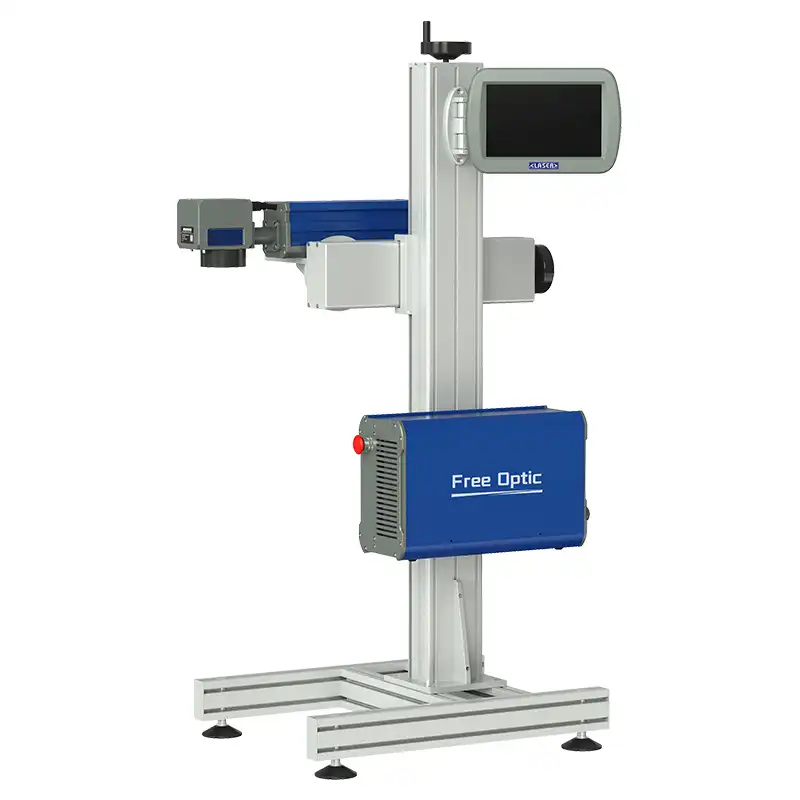
- “Flying Marking”: This is a feature that allows the laser to mark a part while it is moving along a conveyor. An encoder wheel tracks the speed of the conveyor, and the software adjusts the timing of the laser pulses to create a perfect, undistorted mark on the moving target. This is essential for industries like bottling, canning, and wire extrusion, where stopping each part to mark it would be impossibly slow. Implementing flying marking requires the encoder, specific control hardware, and software capable of the task, adding to the system’s complexity and price.
- Robotic Integration: For complex, multi-sided parts, a laser marking machine can be integrated with a 6-axis robotic arm. The robot can pick up a part, present it to the laser at various angles to mark different surfaces, and then place it back on a tray or conveyor. This level of “lights-out” automation is the pinnacle of industrial marking and represents a major capital investment, often costing more than the laser system itself. Companies like specialize in these highly automated, robot-integrated solutions for major manufacturers.
Custom Fixtures and Jigs
Even in a manual operation, efficiency can be dramatically improved with custom fixtures. A fixture, or jig, is a custom-made tool designed to hold one or multiple parts in the exact same position for marking every time.
- For Single Parts: A simple fixture can ensure that every part is placed in the correct orientation and at the correct focal height, eliminating operator error and speeding up the loading/unloading process.
- For Multiple Parts: A larger tray or pallet can be designed to hold dozens or even hundreds of small parts. The operator can load the entire tray, and the software can be programmed to move from one part to the next, marking the entire batch in a single automated cycle.
While a business can create its own simple fixtures, professionally designed and machined fixtures, especially for complex parts or high-volume arrays, are a service offered by machine suppliers. The cost of this custom engineering and fabrication adds to the overall project budget but can pay for itself many times over in saved time and reduced scrap rates.
When budgeting for a laser marking machine, a business must look beyond the base unit and consider which of these advanced capabilities will provide a competitive advantage or a significant return on investment.
Factor 5: The Human Element – Supplier, Support, and Total Cost of Ownership
The final, and perhaps most frequently overlooked, factor in determining how much are laser marking machine investments is the human element. The machine itself is a tool, but the value of that tool is deeply intertwined with the reliability of the supplier who sells it, the quality of the support they provide, and the long-term costs associated with owning and operating it. A lower upfront price from an unreliable source can quickly become far more expensive than a higher price from a reputable partner. This is especially pertinent for businesses in Southeast Asia and the Middle East, where local support can be a critical factor.
Choosing Your Supplier: Local Distributor vs. Direct from Manufacturer
When sourcing a machine, buyers typically have two main options:
- Buying from a Local Distributor: A local distributor or agent often has machines in stock for demonstration, can provide on-site installation and training in the local language, and can respond quickly to service requests. They act as the intermediary, handling importation, taxes, and logistics. This convenience and local support come at a cost, as the distributor’s margin is built into the final price.
- Buying Direct from a Manufacturer: Buying directly from a manufacturer, such as through an online portal like those offered by or other Chinese manufacturers, can often result in a significantly lower initial purchase price. You are cutting out the middleman. However, the buyer is then responsible for shipping, customs clearance, and import duties. More importantly, support and training may be remote (via video call), and getting service or replacement parts can be slower and more complicated.
For many businesses in regions like the Philippines, Vietnam, or the UAE, a hybrid approach is often ideal: working with a manufacturer that has a strong regional presence or a dedicated local support partner. This can offer the best of both worlds—competitive pricing combined with accessible and reliable support. When considering a purchase, asking a potential supplier about their support structure in your specific country is a critical due diligence step.
Warranty, Training, and After-Sales Support
A laser marking machine is a piece of industrial equipment, and like any such equipment, it may eventually require service. A comprehensive warranty and a responsive support team are not just nice-to-haves; they are a form of insurance against costly downtime.
- Warranty: A standard warranty is typically one to two years. It is important to understand what is covered. Does it cover just the laser source or the entire machine? Are parts and labor both included? Who pays for shipping on a warranty repair? A longer, more comprehensive warranty may add to the initial price but provides peace of mind.
- Training: Proper training is essential to get the most out of the machine. Does the supplier provide in-depth training on the software, machine operation, and routine maintenance? Is this training conducted on-site or remotely? Good training empowers your team to operate the machine efficiently and troubleshoot minor issues independently.
- After-Sales Support: What happens when you have a question or a problem after the warranty expires? Does the supplier have knowledgeable technicians available by phone or email? Can they diagnose problems remotely? Do they stock a ready supply of spare parts? A supplier who invests in a strong after-sales support team provides immense long-term value.
Calculating the Total Cost of Ownership (TCO)
The sticker price of a laser marking machine is only the beginning of the story. The Total Cost of Ownership (TCO) provides a more complete picture of the long-term financial commitment. TCO includes:
- Initial Purchase Price: The cost of the machine, shipping, taxes, and any optional accessories.
- Installation and Training Costs: If not included in the purchase price.
- Consumables: For fiber and UV lasers, consumables are virtually non-existent. For glass tube CO2 lasers, the tube itself is a consumable with a finite lifespan and will eventually need to be replaced, which can be a significant expense.
- Electricity: Laser machines are generally efficient, but high-power systems used in continuous production will have a noticeable impact on electricity bills.
- Maintenance and Repair Costs: While fiber lasers are very reliable, other components could potentially fail outside of warranty. It is wise to budget for potential repairs.
- Fume Extraction: Marking many materials (especially plastics and organics) produces smoke and fumes that must be extracted for health and safety. The cost of a good fume extraction unit and its replacement filters should be factored into the initial budget. A quality Laser Marking Machines provider should be able to advise on appropriate fume extraction for your application.
A savvy buyer understands that the cheapest machine is rarely the best value. By evaluating the supplier’s reliability, the quality of their support, and the full TCO, a business can make an investment that will be productive and profitable for many years to come.
A Practical Guide to Budgeting: Price Ranges in 2026
Having examined the five key factors that shape the cost of a laser marking machine, we can now synthesize this information into practical budget ranges. It is crucial to remember that these are estimates for the year 2026 and can vary based on the specific supplier, components, and included services. The central query, “how much are laser marking machine systems,” is best answered by segmenting the market based on the user’s needs and intended application.
Hobbyist & Small Business Entry-Level ($1,500 – $4,000)
This category is for entrepreneurs, hobbyists, and small businesses just starting with laser marking. The focus is on affordability and core functionality.
- What You Get: In this range, you are typically looking at a 20W or 30W desktop/split fiber laser marking machine, or a low-power glass tube CO2 laser. The system will likely use a reputable but cost-effective laser source (like Raycus or Max) and a standard galvanometer and F-Theta lens (e.g., 110x110mm). The software will be the standard 2D version of EZCad.
- Ideal For: Personalizing gifts, marking small batches of products, adding logos to handmade goods, and basic part marking for a small workshop. A startup in Malaysia making custom-engraved phone cases or a jewelry maker in Dubai adding initials to pendants would find their ideal tool in this price range.
- The Bottom Line: These machines provide incredible capability for the price, democratizing access to permanent marking technology. The primary trade-off is speed and the lack of advanced features.
Professional & SME Mid-Range ($4,000 – $15,000)
This segment is for established small to medium-sized enterprises (SMEs), job shops, and businesses with higher production volumes or more diverse marking needs. The investment is larger, but so is the return in terms of speed, versatility, and durability.
- What You Get: This range opens up many more possibilities. You can find higher-power (50W-60W) fiber lasers for increased speed and depth, or even an entry-level MOPA laser for color marking capabilities. High-quality RF-tube CO2 lasers also fall into this category, offering longer life and lower maintenance than their glass-tube counterparts. Entry-level UV lasers for marking sensitive plastics and glass start to appear at the higher end of this range. Machines in this tier often feature higher-quality components (e.g., JPT or IPG sources, faster galvos) and may come bundled with accessories like a rotary device.
- Ideal For: A machine shop in Turkey that needs to mark parts for multiple industrial clients, a mid-sized electronics manufacturer in Vietnam that requires faster throughput, or a promotional products company that wants to offer premium black marking on aluminum.
- The Bottom Line: This is the workhorse category for professional use. The machines are robust, fast, and versatile enough to form the backbone of a marking or engraving business.
Industrial & High-Volume ($15,000 – $100,000+)
This is the domain of large-scale manufacturing and highly specialized applications. Here, the laser is not just a tool but a fully integrated part of a complex production process. The answer to “how much are laser marking machine systems” in this tier is “it depends entirely on the custom solution required.”
- What You Get: At this level, everything is on the table. High-power systems (100W and above) for deep engraving and rapid marking are standard. Advanced UV and MOPA systems with high-end components are common. The key differentiator is automation. This range includes fully enclosed (Class 1) workstations, systems integrated with robotic arms, “on-the-fly” marking for conveyor lines, and custom-engineered solutions with machine vision and automated part handling. The price can climb well over $100,000 for highly complex, bespoke systems, as seen in some advanced pulse laser systems (Hantencnc, 2022).
- Ideal For: Automotive production lines, aerospace component manufacturing, medical device traceability, and any high-throughput environment where speed, reliability, and automation are non-negotiable.
- The Bottom Line: The investment is substantial, but the ROI is measured in fractions of a second saved per part, multiplied by millions of parts per year. At this level, you are not just buying a machine; you are investing in a custom-engineered production solution.
Frequently Asked Questions (FAQ)
1. How much are laser marking machine models for a small business? For a small business, a great starting point is typically a 20W or 30W desktop fiber laser machine, which in 2026 generally costs between $2,500 and $5,000. This is ideal for marking metals and many plastics and is perfect for applications like personalizing products, marking tools, or adding serial numbers.
2. What is the main price difference between a fiber laser and a CO2 laser? At the entry-level, a basic fiber laser and a basic glass-tube CO2 laser can have similar prices. The main price divergence occurs with higher-quality components. An industrial-grade CO2 laser with a long-life RF metal tube will be significantly more expensive than a standard fiber laser of equivalent power. The choice depends entirely on the materials you need to mark: fiber for metals and CO2 for organics like wood and acrylic.
3. Is a more expensive laser marking machine always better? Not necessarily. “Better” depends on your specific needs. A very expensive, high-power machine is “worse” if you only need it for light surface marking, as you have overpaid for capability you will not use. The best machine is the one that meets your application requirements for material, speed, and quality at the most efficient price point.
4. Can I use a laser marking machine for cutting? Generally, laser marking machines are optimized for surface marking and engraving, not cutting. While a higher-power (50W+) fiber laser can cut very thin metal sheet (typically under 1mm), it is a slow process. Similarly, a CO2 laser marker can cut thin wood or acrylic. However, for efficient cutting, you need a dedicated laser cutting machine with a different nozzle design and gas-assist system.
5. Why are UV laser marking machines so expensive? UV lasers are more expensive due to their complexity. They start with an infrared laser source (similar to a fiber laser) and use special non-linear crystals to convert the light’s wavelength into the ultraviolet spectrum. This process, known as frequency generation, requires precise alignment and high-quality, expensive optical components, which drives up the manufacturing cost.
6. What ongoing costs should I expect after buying a laser marking machine? For fiber, MOPA, and UV lasers, ongoing costs are very low, primarily consisting of electricity and potentially replacing filters in your fume extractor. They are considered virtually maintenance-free. For CO2 lasers with glass tubes, the tube itself is a consumable and will need to be replaced after a few thousand hours of use, which represents a significant future cost.
7. How do I choose between a 20W and a 50W fiber laser? Choose a 20W laser if your primary task is surface marking and you are not in a high-volume production environment. It offers the best value for money. Choose a 50W laser if you need to mark parts very quickly (e.g., on a production line) or if you need to do deep engraving into metal. The 50W provides a significant boost in speed and depth for a moderate increase in price.
Conclusion
The exploration of how much are laser marking machine systems in 2026 reveals that there is no single, simple answer. The price is not a fixed number but a dynamic outcome of a series of deliberate choices. It is a reflection of the technology housed within the machine—the power and precision of its laser source, the speed of its components, the intelligence of its software, and the reliability of the people who stand behind it.
An investment in this technology should not begin with a price list. It must begin with an introspective analysis of need. What materials must you mark? What is the nature of the mark—a simple code or a deep engraving? How many parts must you process in an hour, or a day? Will this be a standalone tool in a workshop or an integrated component of an automated factory? Answering these questions brings clarity. It transforms the daunting question of “How much does it cost?” into the more empowering question of “What capabilities do I need to achieve my goals?” Once your needs are defined, the five factors—source, power, components, software, and support—become a roadmap, guiding you toward the right machine at the right price. The final cost is not just an expense; it is a calculated investment in permanence, precision, and productivity for your business.
References
- Hantencnc. (2022). Full list of laser machines. Hantencnc.com. Retrieved from
- Hispeed Laser. (n.d.). Laser machines for marking, cutting, cleaning, and welding. Hispeedlaser.com. Retrieved from
- Laserax. (2025). Laser manufacturer of marking & cleaning solutions. Laserax.com. Retrieved from
- LaserChina. (n.d.). Buy laser welder | cleaner | cutter | marker from manufacturer. Laserchina.com. Retrieved from
- LaserStar Technologies. (2025). LaserStar technologies | Laser welding, marking & cutting systems. Laserstar.net. Retrieved from
- Free Optic. (n.d.). China laser marking machine manufacturers. Free-optic.com. Retrieved from https://www.free-optic.com/laser-marking-machine
- Free Optic. (n.d.). OEM fiber laser marking machine manufacturer and supplier. Free-optic.com. Retrieved from https://www.free-optic.com/fiber-laser-marking-machine
- Ready, J. F. (2001). LIA handbook of laser materials processing. Laser Institute of America.
- Steen, W. M., & Mazumder, J. (2010). Laser material processing. Springer.
- Zaeh, M. F., & Pieczona, S. J. (2006). Laser processing of plastics. Journal of Laser Applications, 18(4), 247-253. https://doi.org/10.2351/1.2355523